Washed Away by Morning: What Sidewalk Chalk Teaches Us About the Limits of Protected Protest
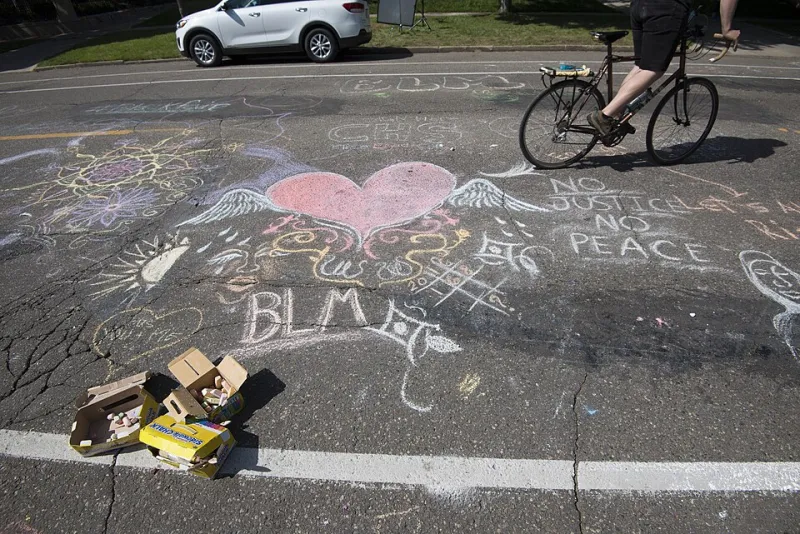
Photo: Fibonacci Blue from Minnesota, USA, CC BY 2.0, via Wikimedia Commons
Few instruments of dissent are as modest as a stick of sidewalk chalk. It costs roughly a dollar, requires no permit, and vanishes with the first passing rainstorm. And yet, across American cities and college towns, chalk has become one of the most frequently policed forms of expression — fined, scrubbed, and occasionally prosecuted — prompting a quiet but consequential legal debate over whether ephemeral speech deserves the same constitutional shelter as a printed pamphlet or a megaphone.
A Medium Built for the Margins
Chalk's appeal to protesters is easy to understand. It leaves no lasting damage, requires no cleanup by the speaker, and can be deployed in seconds. Messages honoring victims of police violence, opposing development projects, or supporting abortion access have appeared on plazas from Portland to Philadelphia. Because the medium is so gentle, many speakers assume it must be legally safe. That assumption is increasingly mistaken.
Municipalities have responded to chalk campaigns with a patchwork of tools: anti-graffiti ordinances, permit requirements, and even criminal vandalism charges. In several widely reported incidents, city crews power-washed chalk memorials within hours of their creation, while police in other jurisdictions photographed messages as evidence. The inconsistency is striking — the same message, in the same medium, may be tolerated in one city and cited as a code violation one bridge away.
The Vandalism Question
The legal crux is whether chalk constitutes a "defacement." Most anti-graffiti statutes were drafted with spray paint and permanent markers in mind, and courts have split on whether a washable medium falls within their scope. Some ordinances explicitly define graffiti to include "any inscription" applied to public surfaces, language broad enough to capture chalk. Others require that the marking be permanent or difficult to remove — a standard chalk plainly fails.
This definitional ambiguity matters because the government's justifications shift depending on the answer. If chalk is vandalism, cities may regulate it under their legitimate interests in preserving public property. If it is speech on a traditional public forum — the sidewalk being the classic example — then any restriction must survive exacting scrutiny: it must be content-neutral, narrowly tailored, and leave open ample alternative channels of communication.
A rule that bans chalk but permits leafleting fails that test in spirit. The Supreme Court has long recognized that regulations may not squeeze expression out of existence by closing every practical avenue. For a protester with no budget, no mailing list, and no press access, a bucket of chalk may be the only channel available. Courts are beginning to grapple with whether "go buy a billboard" is a constitutionally adequate alternative. The honest answer, increasingly, is that it depends on the judge.
Ephemeral Speech, Enduring Doctrine
What makes chalk such a fascinating test case is its transience. First Amendment doctrine evolved around durable media — newspapers, handbills, signs nailed to telephone poles. The assumption was that speech, once uttered, persists and can be answered. Chalk inverts that premise: the message is designed to disappear, and the government's intervention often accelerates a process that nature would complete within days.
Defenders of municipal enforcement argue that the medium's fragility cuts the other way. If the harm is trivial, they reason, the burden of compliance is trivial too — speakers can simply chalk on their own property, or obtain a permit for public events. But this argument understates what makes forum speech meaningful. A message on the courthouse steps speaks differently than the same message in a living room precisely because of where it appears. The sidewalk is not interchangeable with the driveway.
There is also a selective-enforcement problem that should trouble readers across the political spectrum. Enforcement of chalk bans tends to track the content of the message, not the medium. Chalk celebrating a championship win is rarely cited; chalk criticizing a sitting administration more often is. The First Amendment's most basic command — that the government may not favor some viewpoints over others — is hardest to vindicate when enforcement decisions are made by individual work crews and patrol officers, and the evidence dissolves before the lawsuit is filed.
Where the Law Is Heading
Several developments suggest the gray zone is beginning to harden into doctrine. Lower courts have struck down overly broad anti-chalk enforcement as unconstitutional viewpoint discrimination, while upholding reasonable time, place, and manner rules — designated chalk zones, for instance, or prohibitions limited to historic stone surfaces where even washable media can cause staining. The emerging consensus, such as it is, treats chalk as speech, but not speech immune from all regulation.
That balance is defensible. Public institutions have a genuine interest in maintaining infrastructure, and a rule that truly is content-neutral and consistently applied can coexist with robust expression. What the doctrine cannot tolerate is the current status quo in many jurisdictions: a medium that is legal when the message is welcome and criminal when it is not.
For a website devoted to the proposition that every voice counts, the lesson of the chalk cases is an uncomfortable one. The Constitution's protection of speech has always depended on advocates willing to defend unpopular expression in court — but ephemeral messages often vanish before anyone can file a claim. If the next generation of protest is written in a medium that rains can erase, the burden on courts and citizens alike is to ensure that government discretion cannot do the same.