Your Car, Your Billboard: What Courts Say About the Speech You Drive Home
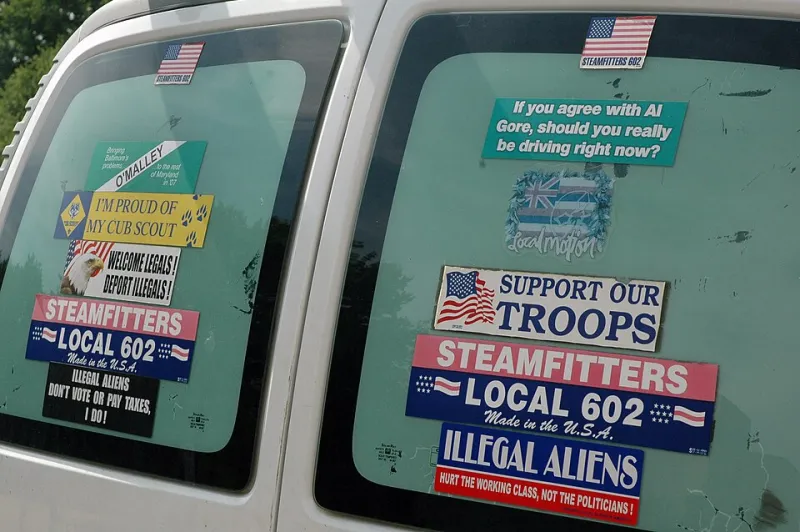
Photo: DimiTalen, CC0, via Wikimedia Commons
Most Americans think of free speech as something that happens at rallies or in comment sections. But some of the most consequential expression in the country happens at 65 miles per hour on a stretch of Interstate 80, or on a front lawn in suburban Ohio. The bumper sticker that announces a political allegiance, the vanity plate that compresses a worldview into eight characters, the yard sign that turns a cul-de-sac into a debate stage — all of it sits at the intersection of personal identity and government power.
And courts have spent decades deciding exactly how far that expression extends.
Vanity Plates: Where the Government Owns the Medium
The legal analysis begins with a distinction that surprises many people: a license plate is state property. Unlike a bumper sticker, which the driver buys and affixes, the plate itself belongs to the state, merely displayed on a private vehicle. That ownership question has shaped nearly every vanity plate case to reach an appellate court.
When states reject plate configurations deemed vulgar, gang-related, or politically provocative, applicants have frequently sued, arguing their approved speech was censored. Courts have generally responded with a framework that treats vanity plates as a form of government speech or, at minimum, a government-designed forum where the state retains significant editorial control. The reasoning goes something like this: the state designed the plate, manufactures the plate, and issues the plate, so the message on the plate can reasonably be attributed to the state itself.
Critics of this doctrine note its malleability. If a plate reading a candidate's name is government speech, what about the pro-life or pro-choice slogans some states have approved? The line between a state endorsing a message and merely hosting one has never been perfectly clean, and circuit courts have not always agreed on where it falls.
Bumper Stickers: The Purest Form of Personal Expression
Contrast the plate with the sticker. A bumper sticker is private property carrying private speech in a public space — arguably the most protected configuration in American expression law. Police cannot pull a driver over because of a political decal, and municipalities cannot ordinance it away. The sticker belongs to the driver in a way the plate never will.
That distinction matters practically. A motorist whose personalized plate is denied has a much steeper legal climb than one whose identical sentiment appears on a magnetic decal. The First Amendment protects the message in both cases; what changes is who controls the paper it is printed on.
Yard Signs and the Homeowner's Front Line
If the license plate belongs to the state and the bumper sticker belongs to the driver, the yard sign belongs to a fight between the homeowner and everyone else — the municipality that wants tidy sightlines, and the homeowners association that wants an unbroken palette of beige.
Local governments have historically imposed size limits, duration limits, and quantity limits on political signage, defending them as traffic-safety and aesthetics measures. Courts have often been skeptical, particularly of rules that treat political signs differently than 'for sale' or 'garage sale' signs. Content-based distinctions — allowing a realtor's sign but restricting a candidate's — have repeatedly failed judicial review, with courts recognizing that a lawn is one of the few remaining venues where an ordinary household can reach the neighborhood without a printing budget.
Homeowners associations present a harder problem. Because an HOA is generally a private actor rather than the government, its sign prohibitions typically fall outside constitutional constraints entirely. The remedy there is legislative: a growing number of states have passed statutes limiting HOAs' ability to ban political signage, with laws specifying permitted dimensions, placement windows, and election-season carve-outs. Texas, Arizona, and Colorado, among others, have all drawn their own lines.
Why the Small Stuff Matters
It is tempting to dismiss a denied vanity plate or a confiscated yard sign as trivial compared to press freedoms or campus speech disputes. But these are the mediums of citizens who will never file an amicus brief or appear on a podcast. For most people, expression law is not about newspapers or social platforms — it is about whether the state can refuse the plate, whether the city can fine the sign, and whether the association can fine the lawn.
The through-line in the case law is deceptively simple: ask who owns the medium. When the government owns it, the speaker usually loses. When the speaker owns it, the government usually needs an extraordinarily good reason to intervene. Everything in between — the sign ordinances, the HOA statutes, the plate-review committees — is a negotiation over the boundary between the two.
Drivers and homeowners would do well to know which side of that line they are standing on before they hit the road or plant their stakes.