Five Landmark Rulings That Built Your Right to Speak — From 1919 to the Feed on Your Phone
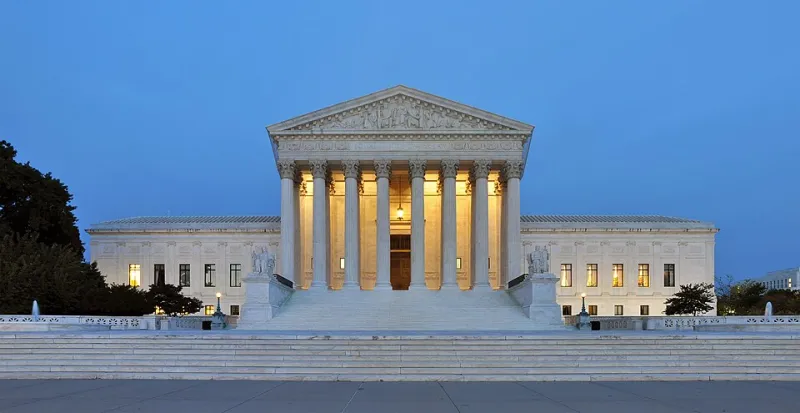
Photo: Joe Ravi, CC BY-SA 3.0, via Wikimedia Commons
Most Americans encounter the First Amendment as a short list of words memorized in civics class. But the amendment's practical meaning—the line between protected expression and punishable conduct—has been drawn and redrawn by the Supreme Court across more than a century of cases. Five of those decisions matter most to the speech you post, protest with, and publish today.
1. Schenck v. United States (1919): The 'Clear and Present Danger' Test
Charles Schenck was convicted for distributing leaflets urging draftees to resist World War I. Unanimously, the Court upheld the conviction, with Justice Oliver Wendell Holmes Jr. offering the famous analogy of falsely shouting fire in a crowded theater.
The case established that speech could be punished when it posed a 'clear and present danger'—and, crucially, that the First Amendment was not absolute. Though the specific test was later abandoned, Schenck began a century of wrestling with a question that remains urgent: how much danger justifies silencing a voice? Today's debates over online calls to violence descend directly from this ruling.
2. Brandenburg v. Ohio (1969): The Imminent Lawless Action Standard
Fifty years after Schenck, the Court corrected course. Clarence Brandenburg, a Ku Klux Klan leader, was convicted under an Ohio criminal syndicalism statute for a rally that included inflammatory rhetoric. The Court unanimously reversed.
Brandenburg established the modern rule: government may punish advocacy of illegal conduct only when it is directed to inciting imminent lawless action and is likely to produce it. Abstract praise of revolution, however repugnant, is protected. This is why hateful rallies occur under police protection in American cities—and why the government cannot prosecute someone merely for voicing extreme views, a protection that applies to every ideology, not just the fashionable ones.
3. Texas v. Johnson (1989): Symbolic Speech and the Flag
When Gregory Lee Johnson burned an American flag outside the 1984 Republican National Convention in Dallas, Texas prosecuted him under a statute protecting the flag's integrity. The Court held, 5–4, that the First Amendment protects symbolic expression, and that the government may not prohibit expression simply because society finds it offensive.
Justice Anthony Kennedy's concurrence captured the principle: the flag protects those who treat it with contempt. The decision remains the clearest statement that viewpoint neutrality is the heart of the First Amendment—the government cannot pick winners and losers in the marketplace of ideas, even when the losing idea is despised by the overwhelming majority.
4. Citizens United v. FEC (2010): Money as Speech in Politics
Few modern rulings draw more criticism than Citizens United, which struck down restrictions on independent political spending by corporations and unions. The Court's logic rested on a familiar foundation: political speech is the core of the First Amendment, and the government may not suppress it based on the identity or wealth of the speaker.
Whatever one thinks of its results, the case directly shapes every election cycle—super PACs, issue advocacy ads, and the ongoing debate over campaign finance reform all trace to it. It also illustrates a recurring tension: regulating speech in the name of fairness often means giving government the power to decide whose speech counts.
5. Packingham v. North Carolina (2017): The Digital Public Square
Lester Packingham, a registered sex offender, was convicted for a statute barring him from social media after a post celebrating a dismissed traffic ticket. The Court struck down the law, with Justice Anthony Kennedy writing that social media users employ platforms for 'all the purposes that the First Amendment protects.'
Packingham affirmed what is now obvious: the modern public square is digital. Blocking access to it wholesale is unconstitutional. The ruling frames today's hardest questions—state laws regulating platform moderation, allegations of government pressure on tech companies, and the difference between private moderation and state coercion.
Why These Cases Belong to You
Notice the pattern: the Court has repeatedly protected speech that majorities loathed—draft resisters, Klansmen, flag burners. That is not an accident of judicial philosophy but the design of the amendment itself. The First Amendment exists precisely for expression that would lose a popularity contest.
These five cases also explain current headlines. When state legislatures pass laws dictating how platforms may moderate content, courts ask the Packingham questions. When officials pressure companies to remove posts, litigants invoke Brandenburg's narrow incitement standard and Bantam Books v. Sullivan's warning against government coercion by other means. When a speaker is denied a permit for a protest, Johnson and Healy supply the answer.
The speech you exercise tomorrow—online, at a rally, in a comment section—stands on these foundations. Knowing them is not an academic exercise. It is the difference between understanding your rights and merely hoping you have them.