The Camera That Knows Your Name: Facial Recognition at Protests and the Search Doctrine's Next Frontier
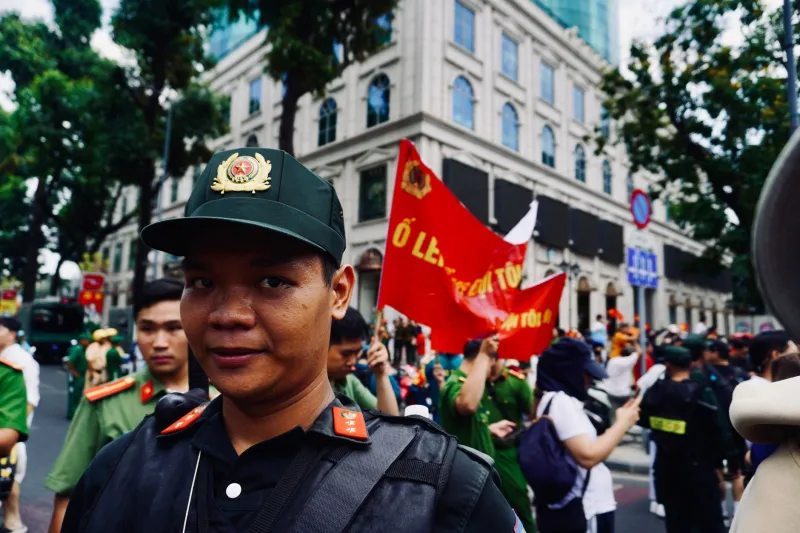
A demonstrator raises a sign outside a city hall. A police officer lifts a phone, frames the crowd, and lets a facial recognition application compare faces against a gallery of booking photos. No warrant is announced. No individual is stopped. The software returns a possible match, and the officer forwards a name to a detective. The encounter lasts seconds, but it raises a question that courts have only begun to answer: when the government uses a camera to identify you in a crowd, has it conducted a search?
The question matters for free speech because surveillance does not need to stop a protest to change it. A person who suspects that a face will be catalogued may stay home, cover up, or avoid carrying a sign with a controversial message. Those choices are difficult to measure, but they are the raw material of First Amendment doctrine. The Supreme Court has long recognized that government action which chills protected expression can violate the Constitution even without a formal ban.
Facial recognition is not new. What is new is its integration into ordinary policing, including at demonstrations. The legal system is now being asked to fit a biometric dragnet into a search-and-seizure framework built for physical trespass and telephone records. The result is a patchwork of local rules, pending litigation, and unresolved doctrine.
What the Constitution Asks
The Fourth Amendment protects people against unreasonable searches and seizures. Under the Supreme Court's decision in Katz v. United States (1967), a search occurs when the government intrudes on a person's reasonable expectation of privacy. Under United States v. Jones (2012), physical tracking can also count as a search. And in Carpenter v. United States (2018), the Court held that acquiring a week of cell-site location records was a search requiring a warrant, even though the data was held by a third party.
Facial recognition in public sits awkwardly within that line. A person in a public square generally lacks a reasonable expectation of privacy in his or her face. Police may observe, photograph, and record what is plainly visible. But facial recognition is not simply observation. It is automated identification at scale, often against databases that the public cannot inspect. The Supreme Court has not ruled directly on whether scanning a crowd with facial recognition is a search. Lower courts and state legislatures are filling the gap.
One argument is that the technology is merely an aid to what officers could do manually. A detective could compare a photograph to a file of mug shots. But manual comparison is limited by time, personnel, and memory. Software can process thousands of faces in minutes. That difference in scale may matter under Carpenter, which emphasized that a person does not surrender all privacy simply by engaging with modern technology.
A second argument is that facial recognition does not seize anyone. It produces a lead. An officer still must decide whether to stop, question, or arrest. But the Fourth Amendment regulates investigation, not only custody. A search can occur before an arrest, and a database query can be a search even when no one is touched.
The Prior Restraint Question
The First Amendment adds a separate concern. A permit requirement for a march can be a prior restraint if officials have broad discretion to deny it. Surveillance can function as a kind of informal prior restraint. If demonstrators know that their faces will be run through a database, some will self-censor before they ever apply for a permit.
The Supreme Court has recognized the link between surveillance and chilled speech. In NAACP v. Alabama (1958), the Court protected membership lists from compulsory disclosure because exposure could deter association. The principle is not limited to membership rolls. Government monitoring of political activity can impose a price on protest even when no law prohibits it.
That does not mean every camera at a protest is unconstitutional. Police have legitimate interests in public safety, crowd control, and investigating crimes. The question is whether the government has adopted adequate safeguards: written policies, retention limits, audit trails, probable-cause standards, and restrictions on using facial recognition to identify people engaged in lawful expressive activity. Without those safeguards, the risk of selective enforcement grows.
The Patchwork of Local Rules
Local policy is where most of the action is. San Francisco banned municipal use of facial recognition in 2019, and several other cities have adopted restrictions or transparency requirements. Some states have enacted laws governing law enforcement use of biometric surveillance. Other jurisdictions have no specific rules at all, leaving the practice to general Fourth Amendment standards and internal department policy.
Federal agencies have their own authorities and oversight mechanisms, but civil liberties groups have argued that the rules are inconsistent and difficult to audit. The result is that a demonstrator in one city may face a regulated, disclosed program while a demonstrator in a neighboring jurisdiction faces an unregulated one.
For organizers, that patchwork is not an abstraction. It determines whether a permit negotiation includes a discussion of facial recognition, whether body-camera footage can be queried with biometric software, and whether a records request will produce a usable policy document.
What the Evidence Says About Chilling
Empirical research on facial recognition at protests is still developing, but the broader literature on surveillance and political participation is consistent. People change behavior when they believe they are being watched. They avoid controversial slogans, decline to be photographed, or choose not to attend at all. Those changes can be rational responses to risk rather than proof of government intent.
That distinction matters legally. A chilling effect can support a First Amendment claim when the government's action is likely to deter protected speech and lacks adequate justification. But courts often demand evidence that the deterrence is real and traceable to government policy. Organizers can help build that record by documenting policy statements, public records, and specific incidents in which attendees were identified or questioned.
A Practical Legal Map
For organizers, the first step is to know the local rules. Request the police department's facial recognition policy, any contracts with vendors, and any logs of queries involving protest footage. Those records can reveal whether a program exists, how it is governed, and whether the department has followed its own rules.
Second, build a legal observer program. Observers should be trained to record stops, searches, and identifications without interfering. They should know the difference between a consensual conversation and a detention. They should also know that probable cause is required for an arrest, while a brief investigative stop requires reasonable suspicion.
Third, plan for digital hygiene. Encrypt communications, use reputable platforms, and avoid sharing identifying information in open channels. That is not an admission that protest is illegal; it is a recognition that surveillance can turn lawful association into a data point.
For attendees, the basic legal framework remains familiar. You have the right to protest in public spaces subject to reasonable time, place, and manner restrictions. You do not have to consent to a search of your person or belongings, but you should not physically resist. If an officer asks for identification, know your state's rules and ask whether you are free to leave. If you are photographed or scanned, you generally cannot stop a camera in public, but you can document what happened and report it to legal observers.
None of this is legal advice for a specific situation. The point is to separate lawful police observation from unlawful surveillance and to give people the information they need to make their own choices.
The Cases to Watch
The litigation now moving through federal and state courts is likely to shape the next decade. Some challenges focus on whether facial recognition is a search under the Fourth Amendment. Others focus on transparency statutes and the adequacy of agency policies. Still others argue that using facial recognition to identify protesters violates the First Amendment because it targets protected association.
The outcomes will depend on facts. A department that uses facial recognition only to identify someone suspected of violence is in a different legal position from a department that runs every face at a demonstration through a database. A policy with retention limits and audit requirements is different from an ad hoc phone app with no records.
That is why the debate should not be reduced to a choice between banning the technology and accepting a surveillance state. The Constitution permits legitimate law enforcement. It also permits regulation. The task for courts and legislatures in 2026 is to draw a line that protects public safety without turning the act of showing up into a permanent identification event.
A face is not a permit. But when the government can identify every face in a crowd, the permit requirement may no longer be the only gatekeeper. The law is still catching up to that reality, and the next round of cases will decide how much of the public square remains anonymous.