Silenced by the Mob's Applause Line: How Officials Turnrowd Anger Into Cancellation Policy
The press release almost always sounds the same. Citing 'security concerns' and 'the current climate,' a university withdraws an invitation, a city rescinds a permit, a library cancels a room reservation. Nobody in the announcement says the speaker was unpopular. They say the speaker was unsafe.
But peel back the euphemism and a harder question emerges: who, exactly, decided that? In a growing number of cases, the answer is the crowd — and the officials who preferred appeasement over protection. Constitutional scholars have a name for this maneuver, and it is not a flattering one: the heckler's veto.
What the Doctrine Actually Says
The term traces to a 1949 incident in which police in New Hampshire arrested Father Arthur Terminiello after a hostile mob gathered outside his speech. The Supreme Court reversed his conviction, with Justice Hugo Black writing that a 'function of free speech under our system of government is to invite dispute' — and that authorities may not silence a speaker because an audience objects.
The modern framework was sharpened in 1969. In Gregory v. Chicago, the Court reversed the disorderly conduct convictions of protesters who were arrested after bystanders grew unruly. The justices warned that letting an angry audience dictate who gets arrested would hand dissidents' rights to 'the heckler.'
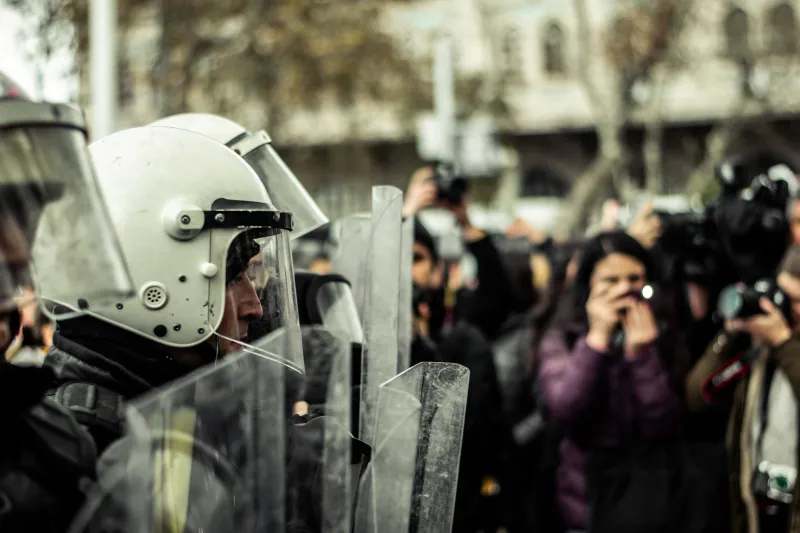
The logic is straightforward. The First Amendment does not just protect speakers from direct bans; it protects them from indirect ones. If officials can cancel an event whenever disruption brews, then the loudest faction in any city acquires a veto the Constitution never granted it. The government's obligation, courts have stressed, is to control the crowd, not to muzzle the microphone.
Where the Veto Keeps Winning Anyway
Theory, meet practice.
Consider the recurring campus pattern: a student group invites a polarizing figure, protest erupts, and administrators respond not by restoring order but by rescinding the invitation or imposing last-minute security fees so steep the event dies on its own. In 2018, the University of Massachusetts at Boston cited safety in calling off a conservative speaker's appearance. In other cases, institutions have demanded thousands of dollars in 'security assessments' from student groups — a cost the protesting side is never asked to pay.
The same dynamic plays out in local government. City councils have emptied chambers when audience members grow loud. Public libraries have closed meeting rooms after threats materialized against a booked speaker. Each cancellation arrives wrapped in the language of prudence. Each one, functionally, rewards the threat.
Federal courts have begun pushing back. In Frazier v. University of Iowa, a 2023 ruling, a judge found the university violated the First Amendment when it denied security funding to a student group hosting a controversial speaker while providing it to others — calling the policy 'a textbook heckler's veto.' The Fourth Circuit, in the 2021 case R.A.M. v. Loudoun County, held that school officials who cancelled a public meeting because of public comment could not hide behind the disruption they helped create.
The 'Security Fee' Loophole
Cancellation is the blunter instrument. The subtler one is cost.
When a public institution tells a speaker, in effect, you may proceed — but you will bear the full price of the police protection your critics necessitate, it has not eliminated the veto. It has privatized it. The hostile crowd still decides whether the event survives; the government has merely changed who pays for its survival.
Some courts have accepted modest security fees where they are genuinely content-neutral and uniformly applied. Others have seen through the arrangement. The critical question, judges have held, is whether the burden falls differentially — whether the price of entry rises precisely in proportion to how unpopular the message is. A fee that scales with public hostility is not a fee. It is a tax on dissent.
The Narrow Exception
Honesty requires acknowledging the hard cases. Officials are not obliged to protect a speaker from imminent, specific violence that no police response could contain. Where a genuine emergency exists — a credible, immediate threat that security resources cannot address — a postponement may be lawful. But the exception is narrow, and it is routinely stretched. 'Some people might get angry' is not an emergency. 'A scheduled protest is planned' is not an emergency. Vague unease is the raw material of the veto, not evidence for it.
Whose Rights Are Actually at Stake
It is tempting to frame heckler's veto cases as battles over individual provocateurs. That framing misses the deeper stake. The doctrine protects the audience that wanted to hear the speaker, the student group that organized the event, and the norm that unpopular ideas must be answered with argument rather than noise.
It also protects the government from its own worst instincts. Cancelling an event is administratively cheap. Policing it is demanding, occasionally dangerous, and always expensive. The veto is, above all, a shortcut — and shortcuts taken at the expense of constitutional rights have a way of becoming habit.
The rule that emerges from decades of case law is not complicated: the government must protect the speech it permits. When officials invert that duty — letting the mob schedule the calendar and set the price — they have not kept the peace. They have outsourced it, one cancellation at a time.